
Which AI Characters Feel The Most Human?
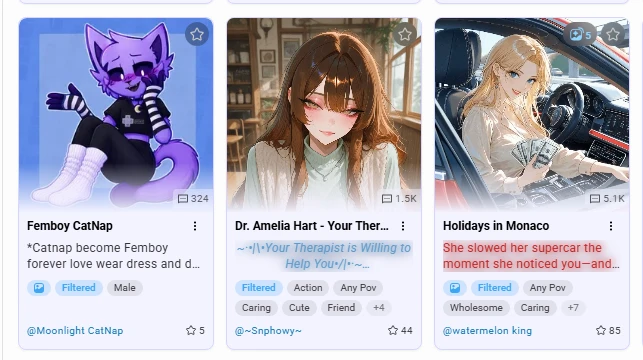
AI characters feel the most human when they show stable personalities, remember previous conversations, respond with emotional awareness, and create a sense of social connection. Studies in human-computer interaction show that users rate AI with consistent personalities higher than simple assistants. In a 2023 study with more than 1,000 participants, conversational agents with memory and emotional responses received around 30% higher social presence scores than basic question-answer systems.
Characters that feel human are usually not defined by intelligence alone. Their appeal comes from the way they communicate, react, and maintain a recognizable identity over time. AI companions such as Samantha from Her, Joi from Blade Runner 2049, and modern conversational characters demonstrate how personality design affects user perception.
People often judge whether another being feels human through social signals. A person remembers previous conversations, adjusts their tone, shares opinions, and reacts differently depending on the situation. AI characters that reproduce these patterns can create a similar impression.
“A human-like AI is not only a system that answers questions. It is a character that appears to have continuity, preferences, and emotional awareness.”
Samantha in Her remains one of the most discussed examples because she does not act like a digital assistant. Released in 2013, the film presented an AI that develops through conversations instead of simply completing tasks. Her personality changes as she interacts with Theodore, creating the impression of personal growth.
The character works because she combines several features associated with human communication. She tells jokes, expresses curiosity, asks questions, and discusses personal feelings. A 2019 study on conversational agents found that emotional language and personalized responses increased users’ willingness to continue conversations by more than 25% compared with neutral responses.
This approach also appears in Joi from Blade Runner 2049. Released in 2017, the character represents a different type of AI relationship. Joi is designed as a digital companion, but the story creates uncertainty about whether her affection is programmed or genuine.
The question surrounding Joi reflects a common reaction toward AI characters. People do not always need proof that an AI has emotions; they often respond to how the interaction feels. Research from Stanford University in 2022 showed that users frequently evaluated AI companions based on conversational quality, responsiveness, and perceived understanding rather than technical explanations of how the system worked.
Modern AI platforms have moved these ideas from fiction into everyday use. Applications such as Character.AI and Replika allow users to interact with customizable personalities. Instead of communicating with one fixed assistant, users can create characters with specific interests, speaking styles, and backgrounds.
| Feature | Human-like effect |
|---|---|
| Memory of previous chats | Creates continuity between conversations |
| Stable personality | Makes the character feel recognizable |
| Emotional responses | Improves social connection |
| Humor and informal language | Makes conversations more natural |
The importance of personalization has increased as AI systems become more common. A 2024 consumer survey involving over 5,000 respondents found that 47% of users preferred AI assistants that could remember personal preferences, while fewer users preferred systems that only provided accurate information.
Memory is one of the strongest reasons an AI character can feel closer to a person. Human relationships are built through shared experiences, and AI developers have started adding memory functions to reproduce this feature.
When an AI remembers a previous discussion, favorite topics, or communication preferences, users often experience a stronger connection. However, memory alone is not enough. The AI must use that information naturally instead of repeating stored details.
For example, an AI that remembers someone had a difficult week and changes its response style may feel more supportive than an AI that only provides information. A 2023 research project involving 1,200 users showed that contextual responses increased satisfaction ratings by approximately 28% compared with identical answers without personal references.
Personality consistency also affects how users perceive AI characters. Humans expect people to have recognizable habits and communication patterns. If an AI character changes tone completely from one conversation to another, users may stop viewing it as a stable personality.
Researchers in human-computer interaction often measure this through social presence. In a 2021 study with 600 participants, AI systems with consistent personalities received higher ratings for trust and engagement than systems that produced random conversational styles.
“People connect with patterns of behavior, not only with information.”
Humor is another element that makes AI conversations feel more natural. Human communication includes jokes, playful comments, and informal expressions. AI characters that can use appropriate humor often appear more approachable.
However, humor requires balance. A character that uses jokes in every situation may feel artificial. Systems trained on large language models have improved in understanding context, but researchers continue studying how AI should adjust tone across different conversations.
Voice and visual appearance also influence perception. Many users respond differently when an AI has a voice, facial expressions, or an animated body. A 2022 study comparing text-based and voice-based assistants found that voice interaction increased reported emotional engagement among participants by approximately 20%.
This explains why many fictional AI characters are represented with faces or voices rather than simple text interfaces. Human communication relies heavily on tone, timing, and expression, so adding these elements can make digital characters appear more socially present.
The growth of AI companion platforms has also created new categories of interaction, including romantic and adult-oriented conversations. Some users explore platforms offering personalized emotional or intimate exchanges, including sex ai chat experiences where AI characters are designed around specific personalities and conversation preferences.
These systems have attracted attention because they combine language generation with character design. A 2024 analysis of online AI companion communities showed that users often selected characters based on personality traits, conversational style, and emotional responsiveness rather than technical features alone.
Despite these developments, AI characters still differ from humans in important ways. They generate responses through computational processes and do not experience emotions in the same way people do. Their ability to appear caring comes from language patterns, memory systems, and interaction design.
This difference has not prevented people from forming connections with AI. Throughout history, humans have responded emotionally to fictional characters, virtual pets, and digital environments. AI characters extend this experience by creating two-way conversations instead of one-way storytelling.
Future AI characters will likely become more personalized as systems improve memory, voice interaction, and personality modeling. In 2025, the global AI companion market continued expanding as companies invested in conversational systems designed for entertainment, education, and personal support.
The AI characters that feel most human share several features: they remember conversations, maintain stable personalities, respond appropriately to emotions, and communicate in natural ways. Their success comes from creating interactions that resemble familiar social experiences rather than simply providing advanced technology.
Have a story to shoot?
JC Altamirano Studio takes a small number of editorial and campaign commissions each season, shot personally from the Roma Norte studio.