
How Custom Jewelry Wholesale Orders Are Priced
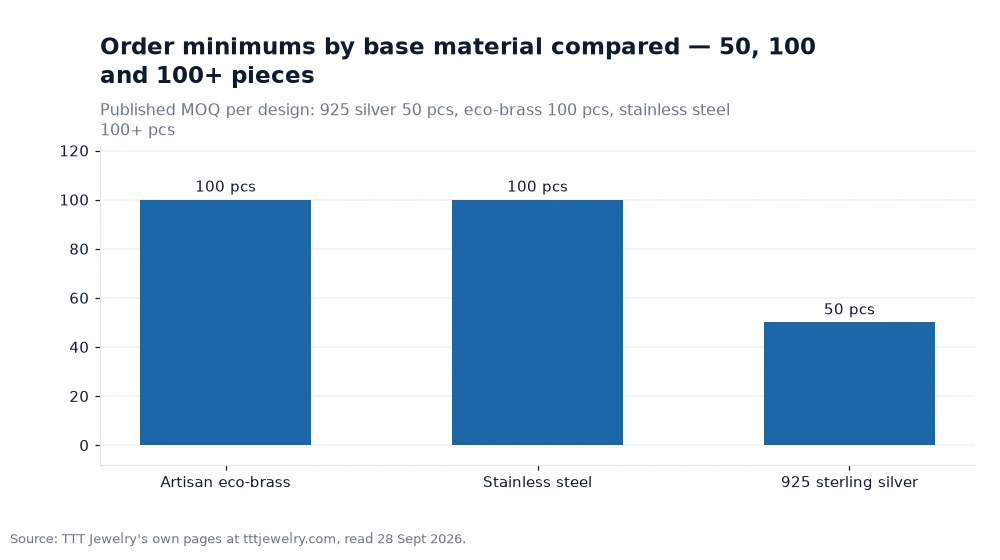
A wholesale quote is not one number pulled from a catalogue. It is five cost blocks — metal, finishing labour, one-time CAD and sampling, packaging and freight — and only some of them shrink as quantity rises. The published minimums show why: 925 sterling silver starts at 50 pieces per design, artisan eco-brass at 100 and stainless steel at 100+. Those figures decide how fixed work is divided long before a buyer sees a unit rate.

Key takeaways
- A quote divides fixed work by the MOQ: 50 silver pieces carry the same setup as 100 brass pieces, so each piece absorbs twice the share.
- CAD is quoted at under 48 hours — 2 days — and sampling at 25–30 days, both charged per design rather than per piece.
- Plating is a line item, not an adjective: multi-layer 14K, 18K or 24K gold or rhodium, an anti-tarnish e-coating, or PVD on stainless steel.
- Mass production runs 3–4 weeks after approval, which puts delivery at roughly 48–60 days from the CAD start when the sample passes first time.
Quote anatomy: five blocks, and the one that divides
A custom jewelry wholesale price sheet usually arrives as a single unit rate, but that rate is assembled from separate blocks. Metal comes first: the CAD model gives a volume, the volume gives a weight, and the weight is priced at the alloy actually specified. Finishing labour comes second: sprue cutting, high-gloss polishing, brushed and textured surface work, then electroplating. One-time work is third — the 3D model, the master and the physical sample. Packaging is fourth, and it is the block buyers underestimate, because a foil-stamped gift box, a velvet pouch, a display backing card, a metallic logo tag and a barcode label are five distinct purchase lines. Freight and duty close the list.
Only some of these blocks move with quantity. Metal scales close to linearly. Finishing labour rises with piece count but not evenly, since a small batch still needs the same bath chemistry and the same bench setup. One-time work does not scale at all: a CAD file costs the same at 50 pieces as at 500. That single fact explains the per-design minimum.
Take a design with a fixed setup of CAD, master model, mould and sample. Publish that setup once and divide it by 50 pieces; each piece carries one fiftieth of it. Divide the same figure by 100 and each carries one hundredth. Doubling the run halves the per-piece share while the setup total stays put. This is why a factory quoting 50 pieces of 925 sterling silver and 100 pieces of brass is not charging silver buyers a premium for nothing: the minimum is matched to the metal and the process route behind it.
The opposite holds too. Two colourways of one design are two runs, two plating batches and, in most plants, two setups. An order of 50 pieces in gold plus 50 in rhodium is not 100 pieces of one thing; the fixed work is paid twice. Consolidating colourways into one 100-piece run is the least disruptive way to cut the per-piece share without touching the design.
| Cost line | Charged per | Effect of doubling the run |
|---|---|---|
| Base metal (925 silver, eco-brass, stainless steel) | Gram weight shown in the CAD file | Close to proportional; small saving from buying one metal lot |
| CAD and master model | Design | Unchanged; the per-piece share halves |
| Physical sample, 25–30 days | Design and revision round | Unchanged; each extra round adds a full 25–30 day window |
| Polishing and surface art | Piece | Rises with count; one bench setup per batch |
| Electroplating: gold, rhodium or PVD | Batch and finish | Rises with count; bath setup paid once per batch |
| Packaging and labels | Piece and SKU | Proportional, with a fixed set of items per SKU |
Plating specifications move the price more than the metal does
A brass ring and a silver ring can leave the same bench looking similar while carrying different finishing costs. Silver and brass take multi-layer precious metal electroplating in 14K, 18K or 24K gold, or rhodium, plus an anti-tarnish e-coating on the base metal. Stainless steel takes PVD vacuum plating instead, and that line is published at 100+ pieces per design rather than 50. The stainless steel jewelry manufacturer page sets out the 316L argument: 2–3% molybdenum, shower-safe wear, and a substrate that holds PVD evenly.
When a rate looks low, read the plating line closely. Gold plated with no karat, no layer count and no top coat is not a specification a buyer can compare against another supplier. Ask for the karat, the number of layers, and whether an anti-tarnish coating is included. REACH and CA Prop 65 compliance on the plating is a separate claim from plating thickness, and both belong in writing before the order is placed.
Where the minimums come from, and where to negotiate
TTT Jewelry publishes three per-design minimums: 50 pieces for 925 sterling silver, 100 for artisan eco-brass and 100+ for stainless steel. The same page lists the six customisation options that feed a quote — base material, plating and finishes, chains and findings, stones and accents, logo and hallmarks, and packaging. Each option adds a line, and most options add setup as well as material.
Negotiation usually goes further on scope than on rate. Moving a design from brass to silver halves the minimum but changes the metal cost. Dropping a two-tone finish removes a plating pass. Standardising one clasp across four designs buys the same finding in a larger lot. None of that requires a discount from the factory; it changes what is being bought, which is the part of the price a buyer actually controls.
The calendar is a cost line too
CAD modelling is quoted at under 48 hours, which is 2 days. Master physical sampling takes 25–30 days, with wax printing, casting, stone setting, polishing and custom electroplating all sitting inside that window. Mass production then runs 3–4 weeks, or 21–28 days. Added together, CAD plus sampling plus production is 48–60 days, roughly 7–9 weeks, before freight.
A rejected sample is expensive in time rather than in metal. One revision round adds another 25–30 days, which is 3.6–4.3 weeks on the calendar and can push a 7–9 week program past a quarter boundary. That is the argument for using the 48-hour CAD window properly: a 0.4 mm correction caught in a drawing costs two days, while the same correction caught in a cast sample costs a month.
Worked example
Three silver designs at 50 pieces each. The one-time block is paid three times — three CAD files, three masters, three samples — while metal and plating are paid on 150 pieces. Per piece, the fixed block works out at 1/50 of one design's setup. Now take the same 150 pieces as two designs at 75 each: the fixed block is paid twice and spread over 75 pieces per design, so the per-piece share falls to 50/75 of the earlier figure, about one third lower. The calendar does not stretch the same way. Three designs sampled in parallel still take 25–30 days once, not 75–90 days, and CAD at under 48 hours per design is 2 days when the files are briefed together. Delivery stays at 48–60 days; only the fixed-cost share moves.
Frequently asked questions
Does a larger order lower the unit price?
Yes, but only through the fixed block. Metal and finishing rise with piece count, while CAD, the master model and the sample are paid once per design. Doubling a run from 50 to 100 pieces halves the per-piece share of that fixed block and leaves the metal line proportional.
Is CAD charged per design or per order?
Per design. Each design needs its own 3D model and its own master, and the 48-hour CAD window is quoted design by design. A five-design collection therefore carries five CAD files and five samples even when all five share a metal, a finish and a clasp.
Can a quote change after the sample is approved?
It can, if the specification changes. Adding a stone, switching from rhodium to 18K gold or adding a second plating pass creates new work and a new line. A quote tied to a written spec, a plating karat and a packaging list is the version that survives sampling.
Reading a quote line by line
A buyer who can name the metal, the karat, the layer count, the clasp, the stone and the packaging on one page is already ahead of most quote requests. The remaining questions are arithmetic: how many designs, how many pieces per design, and how many revision rounds the calendar can absorb. For silver programs, the sterling silver jewelry manufacturer page puts the 925 route and the 50-piece minimum in one place. Compare two suppliers on that page of specification rather than on a headline rate, and the differences that matter become visible.
Source note: figures come from the manufacturer's own website (tttjewelry.com), read 28 Sept 2026.[1]